


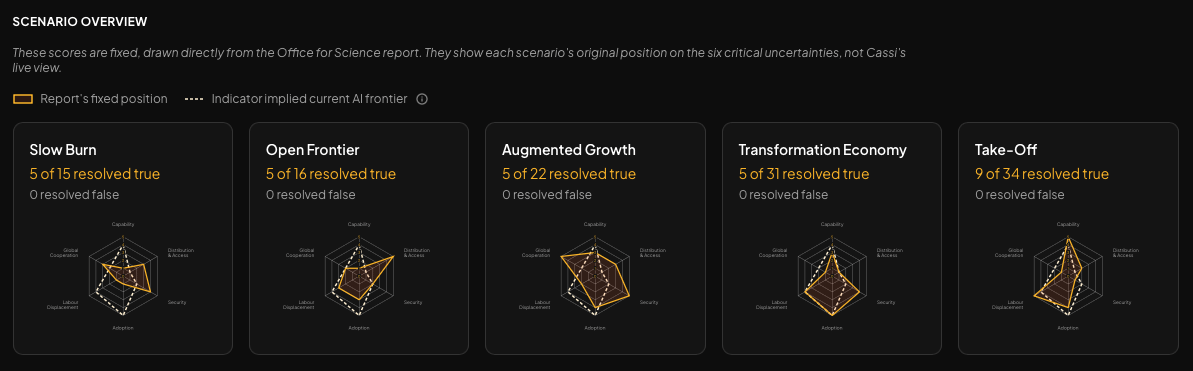
In Cassi’s Forecast Room, Fast Take-Off, the UK Government’s most extreme AI scenario, looks the most likely. Nine of the thirty-four forecasts that underpin the scenario – that is, of the statements, claims and descriptions of what Fast Take-Off would look like per the Government’s report, nine of thirty-four (~27%) have already happened. The Slow Burn has five of fifteen resolved (33%) – but of these, only one is really something that would slow down model progress (public human-text data exhausted). Personally, I read the forecasts that have resolved under ‘slow burn’ all as quite surprising signs of acceleration - I’d encourage you to take a look and see what you think. https://www.cassi-ai.com/forecasts/
Most concerning, Cassi currently forecasts an 81% likelihood that frontier capabilities outpace safety evaluation. Anyone tracking AI progress can see that this is already happening, but resolution here is quite strict: we require ‘the UK AI Security Institute, the International AI Safety Report or a comparable independent authority explicitly states that existing pre-deployment evaluation methods are materially inadequate because frontier capabilities have outpaced them. It will otherwise resolve as false’. Little wonder that there is such alarm among Ministers and Government.
Cassi also forecasts that automation is likely to outpace augmentation in AI usage (65% likely) – in other words, your job is more likely to be taken by an AI, than by someone using AI, to invert the usually reassuring mantra. More reassuringly (maybe), Cassi forecasts only a 38% likelihood that the UK will official document net AI job displacement before 2031 (though a near 40% chance is still v high, and deserves a plan). The ‘maybe’ is because it is important to remember that the forecast here is on what the UK Government will formally document, which could be different to what has actually happened.
It is worth taking a look through to draw out what is most interesting to you in Cassi’s forecasts, and to figure out where you agree and disagree. Cassi is perhaps the world’s leading AI forecaster – given our performance on ForecastBench and Metaculus’ Baseline leaderboard – but it is not omniscient. Figuring out your own forecast allows you to vote, lobby, argue, or plan proportionate to the risk, threat and opportunity we face. Few forecasts, if any, in history have been more important. Which is why we have made the dashboard public.
--
A note on AI forecasting: Superhuman Resolution
Readers might note that there are some forecasts where the probability pathway looks a little odd. For example, this, below – where the probability rose to 100% (i.e. resolved as ‘TRUE’) before being re-opened. This is because we are finding within Cassi that the our auto-resolver is hyper-effective – a good thing, but sometimes leads to surprising forecasts that require our intervention.
The problem is that AI is now better at resolving forecasts than us or our customers. This is often a strength. For example, showing our future-facing dashboard on the UK’s AI Scenarios to a potential client recently, the client was surprised to see that “AI agents autonomously execute regulated financial transactions” had resolved as true, and was interested to understand why. The actual forecasting question below this, is:
Will AI agents be reported as routinely executing consequential financial transactions (e.g. trades or transfers) autonomously within regulated finance before 1 Jan 29?
And it would resolve as true if:
‘TRUE if credible reporting/regulatory documentation confirms routine autonomous agent execution of regulated financial transactions before the date; otherwise FALSE.’
It has resolved as true because, as Cassi describes:
Reuters reported on 2026-07-13 that major banks are embedding agentic AI into daily operations and that such systems can accomplish tasks with minimal human supervision. It specifically reported that at UBS, advisors have agents sending thousands of daily alerts and that, once an advisor decides on a client transaction, “AI agents can trade and complete money transfers.” This is credible reporting of production use in regulated finance involving trades and transfers. Source: https://www.reuters.com/business/finance/wall-street-banks-ramp-up-digital-assistants-bid-to-win-productivity-race-2026-07-13/
For the client, this was surprising, interesting, and useful. Had we limited this to, for example ‘the FCA reports that…’ it would not yet have resolved, similarly, many industry analysts might have missed that this is not a hypothetical question anymore, but a current reality. Cassi is ‘superhuman’ in this respect in that it is usually best to let it find ‘credible sources’ and resolve questions, than to do it yourself, or delegate it to another person or team. However, this introduces its own complexity.
Everything is Resolution Criteria
Resolution criteria are where you define what would you actually see in the world if this thing were to happen or not. You can think of it as like the terms of a bet – I bet you £X that that Arsenal will win the Premier League, and we settle the bet if, at the end of the season, the official Premier League table shows Arsenal are top. But this might not always be sufficient. Suppose Arsenal are later docked points, for some infraction – financial, drugs, whatever, and then didn’t win the Premier League because the second place team are retrospectively awarded the trophy. This might be unlikely, but it is not impossible. For this reason, maybe ‘top on the last published table of the 2026-2027 season’ is the best resolution criteria. But you need to recognise that this is what you are betting on, so you don’t find yourself liable for paying the bet back when the later judgement comes in. It is also then what you are forecasting against - if you keep it as ‘Arsenal win the Premier League’ - it might not resolve as 100% certain on completion of the season and lifting of the trophy. Not being absolutely clear on what qualifies on your bet having happened or not is the source of endless dispute – there is nearly always a loophole - but it also can skew your forecasts if you are not careful. Similar to when you go to make an insurance claim and have to decide whether your claim meets the definition of what is covered. You need to tightly define and understand the ‘resolution criteria’ when making the bet, signing the insurance policy, or setting up your forecast.
When you think of something as broad as a bet on whether AI will make a measurable contribution to growth, you can see why things are sometimes complicated. On 20th July, Cassi resolved this as true.
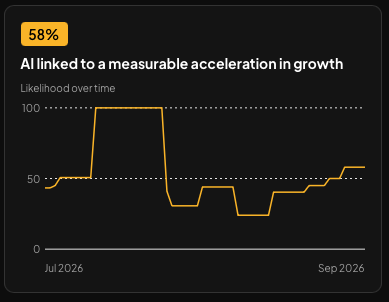
The top level question was Will AI adoption be credibly linked to a measurable acceleration in UK (or advanced-economy) GDP/productivity growth before 1 Jan 31?
The resolution criteria, set when we started forecasting on the AI Scenarios, was:
‘Credibly linked’ = ONS/OBR/IMF/OECD analysis attributing a growth/productivity acceleration substantially to AI. “Augmented Growth (demand side) posits an economic boom restoring early-2000s growth rates; key findings expect substantial productivity gains. TRUE if such analysis linking AI to a growth/productivity acceleration is published before the date; otherwise FALSE.
This resolved as true on 20 July because, as Cassi described:
The IMF’s “United Kingdom: 2026 Article IV Consultation” is listed as Country Report No. 2026/172, dated July 15, 2026, and its report states that medium-term labor productivity growth was revised up while “including a small boost from AI investment and diffusion (0.2pp in line with the OBR)” (https://www.imf.org/en/publications/cr/issues/2026/07/15/united-kingdom-2026-article-iv-consultation-press-release-staff-report-and-statement-by-577619; PDF: https://www.elibrary.imf.org/view/journals/002/2026/172/002.2026.issue-172-en.pdf). This is qualifying IMF analysis credibly linking a measurable productivity-growth acceleration to AI.
Cassi acknowledged that this met the letter, but perhaps not the spirit of the question/issue, explaining that:
The resolution criteria allow resolution before 1 Jan 2031 if analysis by ONS/OBR/IMF/OECD credibly attributes a UK or advanced-economy growth/productivity acceleration substantially to AI. Evidence found after the 10 Jul 2026 open date includes the IMF’s United Kingdom 2026 Article IV report, dated July 15, 2026, which states that UK labor productivity growth was revised upward partly because of “a small boost from AI investment and diffusion (0.2pp in line with the OBR).” This is a named qualifying institution, provides a measurable productivity-growth increment, and explicitly attributes it to AI investment/diffusion. The main ambiguity is whether “small boost” satisfies “substantially”; however, a 0.2 percentage-point productivity-growth effect is a quantified macroeconomic contribution and the criteria’s TRUE condition focuses on publication of such credible analysis. Therefore this appears to have resolved YES on publication.
As a result, we have tightened what qualifies, and Cassi has revised its forecast accordingly.
New criteria root the forecast in a more ambitious statement from the Scenarios, where “Augmented Growth” posits an economic boom restoring early-2000s growth rates, and requires that in the authoritative analysis ‘…this growth or productivity acceleration must have actually occurred, not merely be forecast, predicted or expected to occur.’
Bigger Picture
But the lesson is that resolution criteria are vital for forecasting, and strategic planning - this is why setting out your strategic objectives clearly matters so much - if you are unclear, you will not follow the probabilistically optimal pathway to your outcome. Specificity is a superpower.