


Could there be a worse time for the UK to junk its 2021 ‘Indo-Pacific Tilt’?
There are 10,000 troops from North Korea on their way to fight for Russia in Europe.[i] Just a few weeks ago, in October 2024, Chinese President Xi threatened Taiwan promising ‘the complete reunification of the motherland’ while ramping up military drills around Taiwan’s coast. Many warn an invasion attempt is likely within the next few years.
The CCP seeks to contest the democratic model globally but particularly so in its own region – making the Indo-Pacific the site of this century’s most important ideological competition,[ii] in support of the subversion, sedition and propaganda, the CCP also deploys military[iii] and economic coercion.[iv]
And yet it isn’t primarily military and security reasons that necessitate the tilt. It’s the economy, stupid.
The world’s economic centre of gravity shifts every year deeper into the Indo-Pacific region.[v] By 2030, more than half the world’s economic output will come from Asia.[vi] In the next 10 years a billion more people are expected to join Asia’s middle class, and the consumer market there will be larger than the rest of the world combined.[vii] The way in which digital standards and regulation are set in the Indo-Pacific & Asia will shape our world in the future, making that ideological competition even more crucial – it will determine whether the global model is largely digital democratic or digital authoritarian.
Brexit Hubris?
Germany, the Netherlands, France, and the European Union, all have Indo-Pacific strategies. Italy is said to have undertaken a ‘quiet pivot’ to the Indo-Pacific. A month ago Sweden’s Ministry of Defence has recentlypresented ‘policy direction’ to deepen its engagement in the Indo-Pacific. in January this year France, Germany and Spain sent Air Forces to exercise across the region. France, Germany and the Netherlands all announced their strategies months before the UK’s Indo-Pacific ‘tilt’, making something of a mockery of the politically convenient idea this was all just post-Brexit hubris. It is a region of increasing importance for the world.
Why should the UK care?
Before we come to interests, consider commitments, and culture.
A war in Taiwan is almost certain to draw in Japan, given both US bases there, and the proximity of Japanese islands to Taiwan. It would probably also draw in South Korea. Australia may well also be part of such a conflict, given its even stronger interest in ensuring the CCP’s authoritarian model and economic and military stranglehold on the region does not become so tight as to choke Australia of access to trade and threaten its security.
I hope we would stand beside many of our increasingly close allies in the region. But I find it particularly hard to imagine that the British public would allow a British Government to sit out a war if Australia were heavily involved and suffering significant casualties. If the solidarity we saw in response to the invasion of
Ukraine is any indicator, there would be Australian flags everywhere. Anger if we try to sit it out.
We have interests and commitments in the region too.
We are members of the Five Power Defence Arrangements (FPDA), requiring us to formally consult with Australia, Malaysia, New Zealand, or Singapore in the event of an attack, for the purposes of deciding what measures to take in response. There are regular exercises between the FPDA nations, and a decision not to help, while feasible, would be damaging – why should they trust us in future? What value such agreements if no help follows?
We have interests at stake too. Our economic dependence is considerable. US think-tank CSIS estimated that ~$2.45 trillion of goods transited the Taiwan strait in 2022 (see the brilliant visualisations here). I’d like to hope the National Security Council is well-briefed on the effect a war in the region would have on the UK economy, and our security, with detailed supporting estimates of our supply chain and export dependencies. Public analyses by the Guardian for example, have tended to focus on what we would lose if China stopped trading with the UK because of a war, usually with an acknowledgement of the centrality of Taiwan’s TSMC semiconductor manufacturer to the global economy. But we should worry too about loss of trade with Australia, Japan, South Korea, Singapore, Malaysia, New Zealand. Calculate the cost. Understand the risks.

A war would have a moral, cultural, diplomatic, reputational and economic ‘pull’ on the UK that would be difficult to resist – particularly if, as most anticipate, the war were geographically extensive, protracted, bloody and expensive.
Short of war, we have economic interests to advance, with defence and security actions needed in support.
What was the UK’s Indo-Pacific Tilt?
In short: the prioritisation of the region in accordance with its greater and growing import economically and geopolitically.
The ‘tilt’ was, a corrective to the series of decisions to withdraw from the region ‘East of Suez’ in the 1960s, begun under the Conservative Government of Harold MacMillan, but pushed further and most closely associated with the Labour Government of Harold Wilson and his Defence Minister Denis Healey.[viii]
The ‘tilt’ was also a continuation of a process that began around 2015. when the UK realised how far its diplomatic influence and presence had waned East of Suez, as it tried to deal with the fall out of Parliament’s decision to prevent UK intervention in Syria, and the subsequent spiralling and internationalisation of that conflict by Iran, Russia, and many nations across the Middle East. This was a diplomatic return ‘East of Suez’. [ix] One the ‘tilt’ sought to push into the Indo-Pacific, pre-empting, and hopefully where possible helping to prevent, war and crisis in this region.
The ’tilt’ was also a corrective to the outsourcing of British geopolitical thinking and active diplomacy during the UK’s membership of the EU. The end of the Cold War had seen cuts to defence and diplomatic mission alike, as we ushered in ‘the end of history’. The EU’s diplomatic capacity grew through this period, alongside the outsourcing of UK global trade deals to EU diplomats/trade negotiators. The result was a reduced UK global diplomatic presence, and a less activist diplomatic service – one that had become unused to thinking sharpy about the UK’s national interests. The tilt was an attempt to reemphasis the Indo-Pacific region in line with its increased and growing import, and, along with the Science Superpower agenda, reenergise and refocus the UK’s diplomatic, trade, and security activity there. It did also mean some harder thought as to what UK Defence could do to help deter war in the region, and advance the UK’s interests.
Unfortunately, the ill-fated timing of the UK aircraft carrier deployment to the region, meant it looked much more like a hard-power commitment, and drew criticism. The reality is that deployment was a commitment going back to then Minister Gavin Williamson’s time as Defence Secretary. But the tilt should be judged against the logic of its creation, which is at least as valid and persuasive now as it was in 2020-21.
Why does it matter for the Defence Review?
All this matters so much because the rhetoric around the UK’s ongoing Defence Review is all focused on NATO and Europe. But in truth, the greater threat to the UK comes from the CCP, and a war in Asia. Deprioritise it politically, and you can be sure that it will be eliminated from defence planning assumptions, on which our force design is based. Take away the focus the last Government put on it and all contingency planning across departments, for a war with the CCP, one that would likely threaten our infrastructure, our trade, our industries, will stop.
It also has clear implications for force structure. As I wrote on the Wavell Room in 2022, now is precisely the wrong time to start focusing our investment on rebuilding the British Army on the Rhine (BAOR), land forces to fight on the Continent. Continental powers are now building continental armies, Germany and Poland in particular - which concluded it’s deal for 1000 new South Korean tanks last week, similarly across the Baltic States of NATO’s Eastern edge along with Norway and new Nordic NATO members Finland and Sweden.
Our commitment to NATO need not be measured in Land Forces, and it makes less sense than ever to do so today. Many of the forces that BAOR was there to protect us against – the soldiers of East Germany, and much of Eastern Europe, are now on our side. We are less worried about ‘keeping the Germans down’ i.e. not having too large a German Army, as memories of the Great War, and Second World War, fade, and Germany is seen as a much different nation today. While just as we are stronger, with new allies, Russia is much weaker than the Soviet Union was, and is drawing its allies from Asia.
Another challenge for this review is that it is taking place, at least insofar as we can know from publicly available information, without any central direction as to what the UK’s vital interests are, and absent any principles against which difficult decisions can be made. There is no National Security Advisor, and no integrated review, rather there are, according to various reports more than 10 reviews (possibly, according to some, a lot more) going on concurrently in Whitehall, with the plan being to try to make some sense of how they intersect after they all complete.
When, in 2021, the team I had been a part of in No10, working with the Cabinet Office, published the Integrated Review we described the concept of ‘systemic competition’ where nations such as Putin’s Russia, the CCP’s China, but also Iran and other autocracies, exploit the seams and siloes of our system to avoid scrutiny, exploit it, and damage it. The worry has to be that there are many such seams and silos between all these concurrent reviews.
Systemic competition also recognised the reality of world politics, that all nations compete and cooperate at the same time, even with allies, and within alliances. Abandoning the Indo-Pacific tilt when others are leaning into theirs would be a recipe for retrenchment. Loss of prosperity and power – the ability to get things done.
Principles, Policy, Preparation
In writing of the preparation for the Second World War, and here recall the dire warnings of the imminence of conflict that we have heard around the world from many nations in the last 12-months or so, Britain’s first Cabinet Secretary, Maurice Hankey, wrote of the necessity of having a clear set of principles in order to build a coherent plan to prepare the country for war. Britain’s first principle, he wrote, should be its commitment to peace, since for ‘…a country dependent for its existence on imports of food and raw material, that have to be paid for by exports… peace is the first essential. However, it was unwise to trust that diplomacy, peace and neutrality were ways to avoid war – preparation was the best way to achieve the end of peace. Furthermore, such preparation must be led from the top due to ‘the same considerations which compel the Prime Minister of the day to take charge of the control and direction of war…’ compel that he leads its preparation (i.e. the need for a strong central power in a system designed for decentralisation, one that trends towards duplication, dysfunction, diffusion of responsibility – lack of accountability - on cross-cutting issues, unless there is central grip). Hankey went on to describe the policy that Britain derived from its principles, to which the plan and preparation must be subordinate. These were:
1. That so long as our naval supremacy is assured against any reasonably probable combination of Powers invasion is impracticable.
2. That if we permanently lose command of the sea, whatever may be the strength and organisation of the home force, the subjection of this country is inevitable.
3. That our army for home defence ought to be sufficient in number and organisation not only to repel a small raid, but to compel an enemy who contemplates invasion to assemble such a force as will make it impossible for him to evade our fleets.
4. That to ensure an ample margin of safety such a force may, for purposes of calculation, be assumed to be 70,000 men.
Of course, such a policy would today need to consider the domains of space and cyber, and the threats to UK security that run through them. But in both domains, the greater threat to the UK comes not from Russia and through Europe, but from growing CCP dominance in space and cyber, the risk that digital regulation developed under the CCP dominates globally. For as long as continental powers are building continental armies – which it is in the interests to do - the greatest threat to Britain’s security comes through the cyber, space, and the air and sea domains. Not from land wars in the East of the European continent. If we were dragged into such a conflict, a land force of 150,000 men, double the current force, would still be half the size of the Italian and French Armies. We would need to mobilise a ‘citizen’s army’ – far larger, maybe all voluntary, maybe conscripted. The opportunity cost of a larger standing army would be a loss of flexibility, and diminution in our capabilities in the cyber, space, sea and air domains, where the more direct threats to the UK lie.
As Hankey noted, the first principle must be peace, the first policy priority must be the prevention of ‘invasion’. Forces able to protect UK access to the ‘global commons’ – defined as those areas of the world beyond the control of any one state —sea, space, air, and cyberspace – forces able to protect our supply chains, to minimise attempts at sedition and subversion in the UK. Crucially: forces with the flexibility to support and protect our allies, support and secure our interests, both in Europe and globally.

Leaning into the Tilt
The biggest problem is that tilt is likely to be junked quietly: just not mentioned in the review. For political reasons, this should be accepted. However, some new rhetorical device to emphasise the import of the region and its continued prioritisation will be essential if we are not to see the UK’s regional influence wane once more, and the threats to our security and prosperity increase, as Departments take the signal of its omission to reassign resources and focus elsewhere.
Euro-Atlantic and Indo-Pacific security are indivisible. To deter there, we must deter here, and vice versa. To secure our interests in such a vital region, we must have a clear focus on it, an unmissable signal in the Prime Minister and his Cabinet’s communications and later the various strategies including the Strategic Defence Review, that the region must remain a focus for Whitehall, a diplomatic, trade, and defence priority. Without clear principles and policies, politics and local departmental priorities will see the end of the tilt’s prioritisation of the Indo-Pacific, at precisely the worst time.
[i] According to the UK Ministry of Defence, some almost certainly (>90% likelihood) fighting against Ukrainian forces in Kursk, with more set to fight for Russia on other fronts in Ukraine.
[ii] https://www.aspi.org.au/report/truth-and-reality-chinese-characteristics
[iii] https://www.aspistrategist.org.au/chinas-blue-dragon-strategy-in-the-indo-pacific/
[iv] https://www.hybridcoe.fi/wp-content/uploads/2023/10/20231026-Hybrid-CoE-Working-Paper-25-Chinese-economic-coercion-WEB.pdf
[v] Numerous charts and analyses show this, though I have not found a recent update to them – most report it as an accepted fact.
Or Fig 1.3 below from Sainsbury, D., 2020. Windows of opportunity: How nations create wealth. Profile Books.
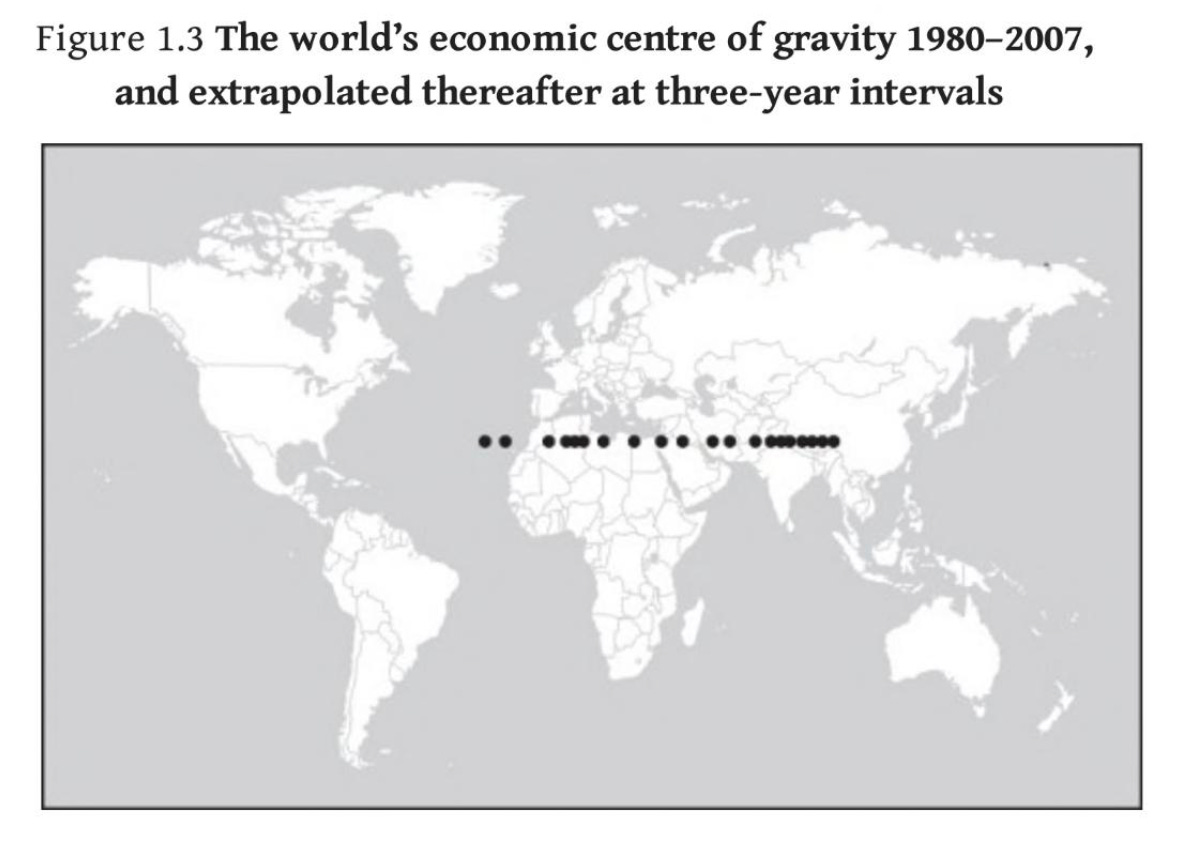
In 2023, the UK Department of Business and Trade reported that “The world’s economic centre of gravity will continue to shift eastward.” ‘https://www.gov.uk/government/publications/global-trade-outlook-february-2023-report/global-trade-outlook-february-2023-html-executive-summary
[vi] Ibid.
[vii] https://www.dfat.gov.au/sites/default/files/minisite/static/4ca0813c-585e-4fe1-86eb-de665e65001a/fpwhitepaper/foreign-policy-white-paper/chapter-two-contested-world/indo-pacific-will-create-opportunity.html
[viii] James, William D., '‘The most momentous shift in our foreign policy for a century and a half’: British grand strategy and the ‘East of Suez’ decision(s)', British Grand Strategy in the Age of American Hegemony (Oxford, 2024; online edn, Oxford Academic, 22 Feb. 2024), https://doi.org/10.1093/oso/9780198896609.003.0004, accessed 3 Nov. 2024.
[ix] "The New East of Suez Question: Damage Limitation after Failure Over Syria". Royal United Services Institute. 19 September 2013. Archived from the original on 2 July 2015. Accessed 3 November 2024.